Air Knives
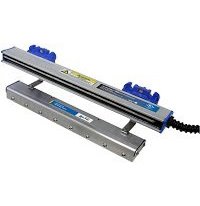
Utilizing a durable, patented technology which results in significantly less noise, less compressed air usage and a...
Learn More
Air Knives
Air knives are tools that produce a uniform sheet of clean, pressurized air to blow liquid, dust, and debris from surfaces and objects. They are powered by compressed air delivered in a laminar airflow pattern in which the velocity and direction are uniform. This makes air knives an efficient method of removing moisture and other particulates from wide areas and large assemblies without any mechanical contact.
Air knives are typically used in manufacturing and recycling applications. The impact air velocity can be adjusted from a gentle breeze to a powerful curtain of air/Beam, giving these tools the versatility to handle a wide range of applications. In addition to cleaning, air knives are used for drying and cooling products.
How Do Air Knives Work?
Air knives consist of a body with a plenum chamber, cap, and uniform continuous gap that provides an exit for the pressurized air. Most air knives are used in conjunction with conveyor belt systems. The air knife is stationary while objects pass through the high-velocity airstream, where liquids and debris are removed prior to packaging. Common applications include:
- Conveyor cleaning
- Parts drying
- Component cooling
- Drying or cleaning of moving webs, film, sheets, or strips
- Scrap removal
- Pre-paint blowoff
- Bag opening in filling applications
Air knife systems are used in various Industries including food and beverage, Automotive, Packaging, Medical, Pharmaceutical, Metal Forming and Fabrication, and Textiles.
Benefits of Air Knives
Air knives provide many benefits compared with other cleaning and drying systems. These include:
- High-performance, energy-efficient cleaning
- Less expensive than fans and blowers
- Quiet operation that meets OSHA noise specifications
- More uniform cleaning of large surfaces than nozzles or jets
- Maintenance-free; contains no moving parts
- Dries parts quickly and thoroughly, even those with complex shapes
- Space-saving design easily configures to existing conveyor system
- Provides a cleaner surface for painting or coating
- Precise and repeatable action delivers consistent quality results
- Can be used in harsh, corrosive, sanitary, and wash-down environments
Simco-Ion air knives utilize a durable, patented technology that results in significantly less noise, less compressed air usage, and a reliable, uniform airflow. When coupled with our intelligent, high output static bar, they clean while neutralizing static charges.